
FIFA International Soccer introduced a style of football that immediately looked and felt different from many football games of its era. Released first in 1993, the game combined a distinctive diagonal view of the pitch with direct player control, individual player attributes, formations, tactical strategies, team coverage, passing, shooting, lobs, headers, volleys, bicycle kicks, tackles, set pieces and multiplayer football.
The result was neither a pure arcade football game nor a simulation in the modern sense. FIFA International Soccer was designed to be immediately playable, but underneath its relatively simple controls was a surprisingly detailed football system. The human player normally controlled one footballer while the game managed the movement and decisions of the remaining players, creating a constant interaction between manual control and computer-controlled team behaviour.
The game's mechanics were also closely connected. Formation determined the team's basic shape. Team Coverage influenced where defenders, midfielders and attackers operated. Team Strategy changed the overall approach of the side. Individual attributes differentiated the footballers, while directional input, timing and power determined what happened when the user passed, shot or challenged for the ball.
Understanding FIFA International Soccer therefore requires looking beyond its famous isometric-style camera. Its gameplay was built from a collection of interconnected systems that established many of the ideas EA would continue developing throughout the FIFA series.

How FIFA International Soccer Gameplay Works
At its core, FIFA International Soccer is a direct-control football game. The user controls an active footballer while the computer handles most of the positioning and behaviour of the other players. As possession changes, the available actions change with it.
A footballer in possession can dribble, pass, lob or shoot. A defending player can pursue the ball carrier, change the controlled footballer and attempt tackles or physical challenges. When the ball is airborne, contextual actions allow players to attempt headers, volleys and bicycle kicks.
This contextual design allows a relatively small number of buttons to control a surprisingly large collection of football actions.
FIFA International Soccer should not, however, be described as using the type of continuous physics simulation found in modern football games. The game's behaviour is produced through a combination of directional movement, player ratings, programmed football rules, contextual actions, animation sequences and ball trajectories.
There is also an important limit to what can accurately be said about its internal engine. EA's manuals explain how the gameplay systems behave from the player's perspective, but they do not publish the original source code or document every internal algorithm. Exact claims about finite-state machines, collision formulas, pathfinding routines or the mathematics behind ball movement would therefore go beyond the available technical evidence.
The Diagonal Isometric-Style Pitch
The most immediately recognisable part of FIFA International Soccer is its elevated diagonal view of the field. Instead of presenting football directly from the side or directly from above, the pitch is displayed at an angle.
This gives the player a broad view of the field while preserving visible depth between the footballers. It also has a major effect on gameplay because the apparent directions of movement do not correspond as naturally to a conventional horizontal television view.
The diagonal geometry influences almost everything the player does. Running toward goal, tracking an opponent, finding a passing lane and aiming a shot all require an understanding of the angled pitch.
EA accounted for this with different directional-control options on versions such as the Super Nintendo release. The default control method is designed around the orientation of the field, while an alternative method changes how controller directions correspond to movement on screen.
Learning the relationship between controller input and the diagonal field is therefore one of the first skills required to become comfortable with FIFA International Soccer.

Player Movement
Movement is direct and responsive. The directional controls determine where the selected footballer moves, while the characteristics of individual players affect how effective they are on the field.
The game does not attempt to model every foot placement or change of body weight through modern physical simulation. Turning and running are comparatively discrete, giving movement the distinctive sharpness associated with the early FIFA games.
That simplicity is important to the pace of the game. Players can change direction quickly, chase loose balls and move between attacking and defensive situations without lengthy transition animations.
The system can also create the familiar zig-zag dribbling associated with early FIFA. Rapid directional changes can make a ball carrier difficult to challenge because defenders must continually adjust their approach.
Dribbling and Ball Control
When a footballer gains possession, the ball remains closely connected to his movement during normal dribbling. The game does not continuously simulate every individual touch between the player's feet and the ball.
Instead, possession creates a controlled relationship between footballer and ball until another event changes it. Passing, shooting, tackling, deflections, aerial challenges and losing possession can all break that relationship and send the ball into another phase of play.
This close control makes dribbling accessible but does not make every footballer identical. Ball Control is one of the individual player attributes represented by the game, alongside qualities such as Speed, Skill and Agility.
The combination of close dribbling and directional movement means that beating a defender is often about timing a change of direction rather than performing the extensive catalogue of skill moves found in later FIFA games.
Passing
Passing in FIFA International Soccer places considerable importance on direction. The user chooses where the footballer should send the ball and can influence the strength of the pass through the kick-power system.
This makes passing more manual than in modern FIFA and EA Sports FC games. Contemporary football games contain extensive contextual assistance for identifying likely receivers and adjusting passes around nearby players. The original FIFA uses a much simpler relationship between directional input, player position, power and the location of teammates.
Short passes can be used to maintain possession, while stronger passes move the ball across greater distances. Because the pitch is diagonal, accurate passing also depends on becoming comfortable with the field's unusual geometry.
Passing is represented as an individual player quality as well. Players have a Passing attribute, so squad selection can influence the quality available in different areas of the field.
Lobs and Chipped Balls
The game provides a separate lobbed-ball action. Instead of keeping the ball on the ground, the player can lift it into the air.
Lobs can be used to move the ball over opponents, find teammates farther up the field or create aerial situations around the penalty area. Once airborne, the ball can lead to headers, volleys and other contextual actions.
The ability to deliberately lift the ball gives FIFA International Soccer an additional dimension beyond simple ground passing. Players must consider not only the direction and distance of a pass but whether moving the ball through the air provides a better route.
Pass and Kick Power
Power is an important part of the control system. Holding the appropriate action button allows the player to put greater strength into a kick, while a shorter press produces a less powerful action.
This applies to important actions such as passes, shots and other kicks. It means that selecting an action is only the beginning of the input. The user must also judge how much power the situation requires.
Too little power can leave a pass short of its target. Too much can send the ball beyond a teammate or make an attempt at goal less useful. Direction and power therefore work together.
This was an important way of creating variation without requiring a large number of dedicated buttons for different pass and shot types.
Shooting
Shooting follows the same general design philosophy. The player chooses a direction, controls the strength of the kick and attempts to beat the goalkeeper from a suitable position.
Individual footballers are differentiated through Shot Power and Shot Accuracy ratings. A player's abilities therefore matter in addition to the user's input.
The shooting system is considerably more predictable than a modern physics-heavy football engine. Through repeated play, experienced users can learn particularly effective shooting positions and angles.
That predictability is an important part of mastering the game. Knowledge of the engine becomes almost as important as conventional football knowledge. Players learn how goalkeepers react, where shots tend to travel and which approaches consistently create dangerous attempts.
Aftertouch
One of FIFA International Soccer's more advanced ball-control features is aftertouch. After a kick, the user can apply directional input to influence the path of the ball.
The feature gives the player an additional degree of control after the initial shot or kick has been made. Instead of every trajectory being completely fixed at the instant of contact, the user can influence the flight while the ball is travelling.
The precise controller input varies between platforms, but aftertouch is part of the documented gameplay system and appears in the control schemes of the original game.
It is simple compared with the sophisticated spin, aerodynamics and ball-physics systems used decades later, but it added another skill element to long-range shooting and airborne delivery.
Headers, Volleys and Bicycle Kicks
Airborne football is handled contextually. When the ball reaches a footballer at an appropriate height and position, the game can produce a header, volley or bicycle kick according to the situation and input.
The user does not choose from a modern menu of individual animation types. Positioning, timing and the state of the ball help determine what action occurs.
Headers and bicycle kicks are also represented within the player-rating system. The presence of separate Headers and Bicycles attributes shows that EA intended footballers to have different abilities in these situations rather than treating every player identically.
Bicycle kicks became one of the memorable visual features of the early FIFA games because spectacular attempts could emerge from ordinary attacking situations when the positioning and timing were right.
Advanced Attacking Actions
FIFA International Soccer contains more attacking techniques than its basic controls initially suggest. Depending on the platform and controller configuration, players can perform additional actions and combinations beyond ordinary passing, shooting and lobbing.
Documented versions include techniques such as backheels and combination passing. These allow the player to move the ball in less conventional ways or combine with teammates instead of always attacking through direct dribbling.
The exact button combinations differ between platforms, which is why a universal controls list can be misleading. A Mega Drive controller, Super Nintendo controller and PC keyboard do not provide identical inputs even when the underlying football action is shared.
Defending
Once possession is lost, the same match immediately becomes a defensive problem. The user controls a selected defender while the computer continues to manage the remaining members of the team.
The player can pursue the opponent, switch to another footballer and attempt to win possession. Positioning is especially important because charging directly toward the ball can pull a defender away from the team's shape and create space for the opposition.
This relationship between manual defending and computer-controlled positioning is one of the central mechanics of the game. The user is responsible for the immediate challenge, while formation, strategy and coverage continue to influence the players who are not being manually controlled.
Tackling and Physical Challenges
Sliding tackles provide a direct method of attempting to dispossess an opponent. Timing is critical because a successful challenge can win the ball, while a poorly timed tackle can miss completely or produce a foul.
Other physical challenges are available depending on the platform and control layout. These give defenders alternatives to simply running into the path of the attacker.
Sliding ability is represented as an individual player attribute, while Aggression is another characteristic assigned to footballers. However, the surviving documentation does not provide enough technical information to state exactly how every rating modifies every defensive calculation.
The safest description is that player attributes differentiate footballers, while the tackling system evaluates the action within the circumstances of the match.
Fouls, Yellow Cards and Red Cards
Aggressive defending has consequences. FIFA International Soccer supports fouls and disciplinary cards, allowing mistimed or illegal challenges to result in free kicks, penalties and punishment for the offending player.
Yellow and red cards can be part of the match depending on the game configuration. A red card reduces the team to fewer players, changing the positional balance for the remainder of the match.
The inclusion of discipline is important because it prevents tackling from being completely consequence-free. The user has to balance the advantage of an aggressive challenge against the possibility of conceding a dangerous set piece or losing a player.

Goalkeepers
Goalkeepers operate differently from ordinary outfield footballers. Much of their fundamental positioning and shot-stopping behaviour is computer controlled, allowing the user to concentrate on the active outfield player during normal play.
When a goalkeeper gains possession, the ball can be distributed back into play. Depending on the situation and version, different actions allow the keeper to throw or kick the ball toward teammates.
Goalkeeping ability is also recognised within the broader team-rating system. Teams can therefore differ not only in passing, running, shooting or defending but also in the quality associated with their goalkeeper.
Like other computer-controlled behaviour in the game, goalkeeping becomes increasingly readable through experience. Regular players learn how keepers respond to particular shooting positions and trajectories, creating opportunities to exploit recurring patterns.
Set Pieces
FIFA International Soccer models the principal restarts required for a football match, including kick-offs, throw-ins, goal kicks, corners, free kicks and penalties.
Set pieces temporarily change the normal flow of play and place the ball into a controlled restart situation. Direction remains central to the system, while certain restarts provide additional targeting or kicking controls.
Corners and goal kicks allow the player to choose where the ball should be delivered. Free kicks provide an opportunity to pass or attempt a direct attack, while penalties reduce the contest to the kicker and goalkeeper.
The design remains consistent with the rest of FIFA International Soccer: relatively few controls are combined with direction, power and context to produce different football actions.
Football Rules and Match Options
FIFA International Soccer models more than the basic objective of scoring goals. The game recognises the boundaries of the pitch and supports throw-ins, corners, goal kicks, free kicks and penalties when play is stopped.
Offside can also form part of the match rules. This prevents attackers from simply remaining beside the opposing goal waiting for a forward ball and forces attacking players to operate within a more recognisable football structure.
Fouls and disciplinary rules can likewise be included according to the selected match setup.
These options allow FIFA International Soccer to move between a freer action game and a match that observes more of association football's normal restrictions.
Action and Simulation Gameplay
FIFA International Soccer includes an important distinction between Action and Simulation approaches to play.
Action is designed around immediate football and reduces some of the longer-term effects that influence player performance. Simulation gives greater importance to elements such as stamina, allowing fatigue to become more relevant during a match.
Stamina is itself one of the individual player attributes, so this setting connects the match configuration with the abilities assigned to individual footballers.
This is an early example of an idea that would remain important throughout the history of football games: some players want fast and accessible action, while others want more of the limitations and consequences associated with real football.
Player Attributes
FIFA International Soccer differentiates individual footballers through a collection of ratings rather than treating every player on the pitch as mechanically identical.
The documented individual player attributes include:
- Skill
- Speed
- Aggression
- Ball Control
- Shot Power
- Shot Accuracy
- Agility
- Bicycles
- Headers
- Slides
- Stamina
- Passing
- Reaction
The list provides a useful picture of what EA considered important to the gameplay. Running speed is separated from agility. Shot power is separated from accuracy. Passing, ball control and aerial abilities have their own ratings, as do sliding tackles and stamina.
The documentation does not reveal the exact mathematical weighting of these attributes. It would therefore be inaccurate to claim, for example, that a specific increase in Reaction changes a player's response time by a known number of frames.
What can be established is that these ratings create the individual layer underneath the broader team and tactical systems.

Team Ratings
Individual attributes are complemented by broader team ratings. These provide an overview of a national team's strengths and weaknesses in major areas of play.
Teams are evaluated in football categories such as shooting, running, passing, defence, tackling and goalkeeping. This helps explain why choosing a different national team can produce a different experience even before the user changes formation or strategy.
Team ratings and individual player ratings serve different purposes. The team values summarise the overall qualities of the side, while individual attributes describe the footballers available within the squad.
Formations
FIFA International Soccer provides five principal formations:
- 3-5-2
- 4-4-2
- Sweeper
- 4-2-4
- 4-3-3
Formation establishes the basic positional structure of the team. It determines the distribution of defenders, midfielders and attackers before the additional effects of strategy and coverage are applied.
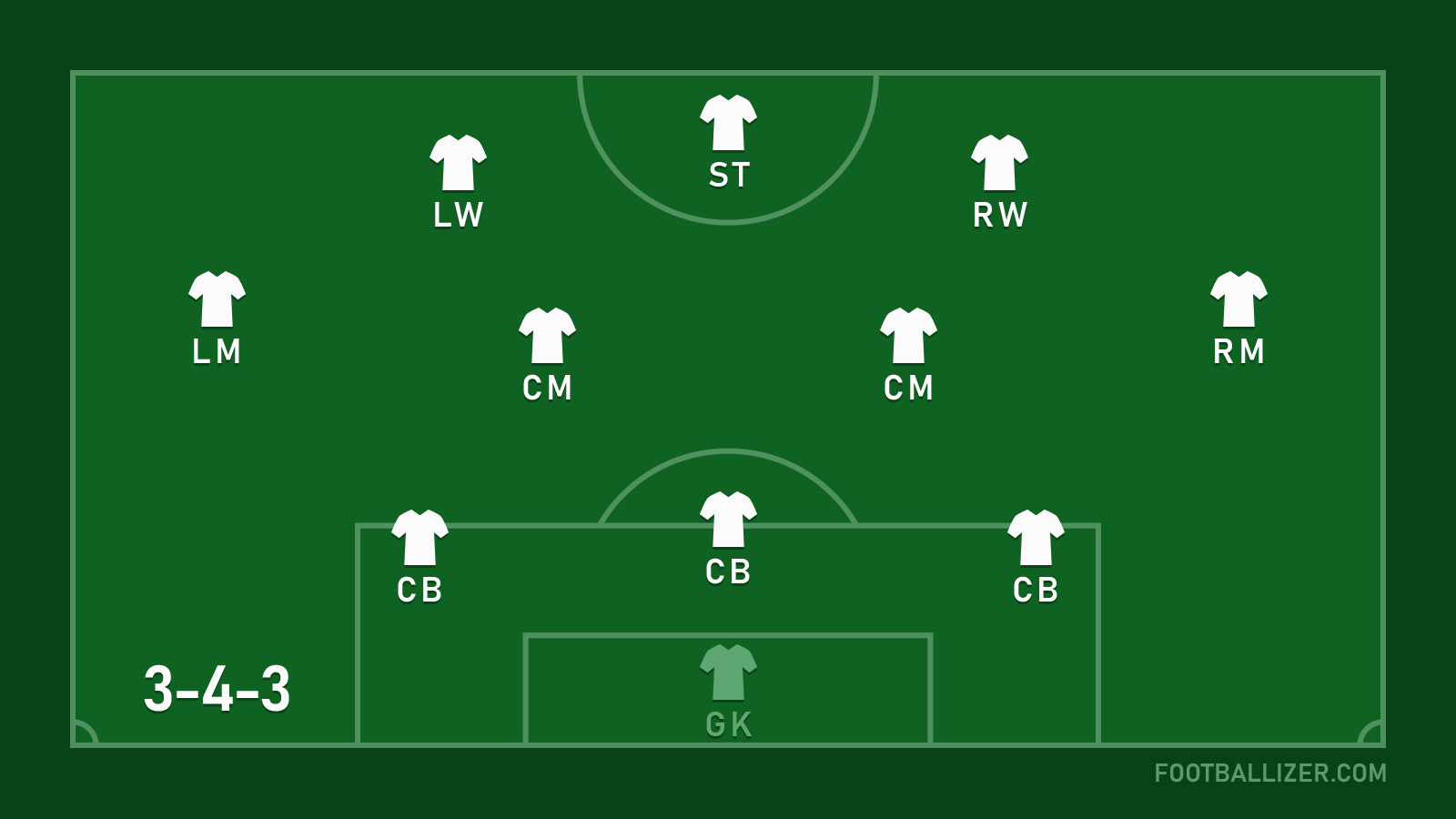
The 3-5-2 concentrates more players in midfield, while 4-4-2 provides a conventional balance between the three main lines. The 4-3-3 uses three forwards, and 4-2-4 commits four players to the attacking line at the cost of midfield numbers.
The Sweeper setup introduces a deeper defensive role behind the principal defensive line.
These formations are not merely visual diagrams in the menu. They provide the positional framework from which the computer-controlled players operate during the match.
Team Strategy
Formation determines the team's basic shape, but FIFA International Soccer separately allows the user to select a Team Strategy.
The documented strategy choices include Auto, Long Ball, All Out Defend, Attack, Defend and All Out Attack.
Long Ball creates a more direct approach, moving play quickly from defensive areas toward the forwards. Defend and All Out Defend encourage a more conservative team shape, while Attack and All Out Attack increase the team's offensive commitment.
The distinction between formation and strategy is important. Two teams using the same formation do not necessarily have to approach the match in the same way. Their basic positions can remain similar while their overall behaviour changes.
Team Coverage
One of the most interesting tactical mechanics in FIFA International Soccer is Team Coverage. This allows the user to influence the areas in which the defensive, midfield and attacking units operate.
Defensive coverage can be moved farther forward, allowing defenders to operate higher up the field. The trade-off is additional space behind them, increasing the danger when an opponent attacks quickly.
Midfield coverage determines how widely the midfield unit contributes between defence and attack. A broader range can help connect the different areas of the team, while positioning the unit incorrectly can leave important areas exposed.
Attacking coverage determines where the forwards tend to operate. This becomes particularly relevant when combined with Team Strategy. A Long Ball approach can leave attackers farther forward as targets, while a defensive approach requires a different relationship between the forward line and the rest of the team.
Formation, Strategy and Coverage therefore perform three related but distinct jobs. Formation establishes the structure, Strategy establishes the overall approach, and Coverage adjusts the operating areas of the team's positional units.
How the AI Works in FIFA International Soccer
Artificial intelligence is fundamental to FIFA International Soccer because the human user normally controls only one footballer at a time. The computer must continuously handle the remaining players on both teams.
This includes off-the-ball positioning, maintaining the team's general structure, supporting possession, defending space, responding to changes of possession and controlling the opposition.
The original documentation does not reveal the source code or describe a named internal AI architecture. It would therefore be inaccurate to state as fact that FIFA International Soccer uses a particular decision-tree system, finite-state machine, pathfinding algorithm or set of mathematical AI weights.
What can be described accurately is the visible and documented tactical framework within which computer-controlled players operate.
Off-the-Ball Positioning
Computer-controlled footballers do not simply remain at fixed coordinates on the field. The formation establishes their basic positional responsibilities, but they move as the location of the ball and the state of possession change.
Defenders, midfielders and forwards consequently occupy different areas and provide different forms of support. When the human-controlled player advances with the ball, teammates reposition themselves around the attack. When possession is lost, the team reorganises defensively.
This movement is simpler and more predictable than the positional intelligence found in modern football games, but it is essential to making FIFA International Soccer function as a team sport.
AI and Team Coverage
Team Coverage provides one of the clearest documented links between tactics and computer-controlled positioning.
Increasing defensive coverage pushes the area in which defenders operate farther upfield. This can help the team compress play but also creates greater space behind the defence.
Midfield coverage changes how extensively midfielders operate between the defensive and attacking areas. Forward coverage similarly influences where attackers position themselves in relation to the rest of the side.
The result is that the AI's positioning is not based solely on a footballer's nominal formation position. The tactical configuration also influences the area in which that unit is expected to work.

AI and Team Strategy
Team Strategy changes the collective behaviour surrounding the player under human control.
Under a Long Ball strategy, the team's positioning supports more direct movement toward advanced players. Defensive strategies keep more support in conservative areas, while attacking strategies allow greater numbers to operate farther forward.
These settings matter precisely because most footballers are computer controlled. If every player had to be moved manually, a team strategy option would have little practical meaning. Instead, the strategy provides instructions that the game can apply to the footballers the user is not currently controlling.
The Auto Strategy
Auto is particularly significant when examining the game's AI. With Auto selected, the computer can choose a team strategy and change that strategy when it considers a change appropriate.
This gives FIFA International Soccer a basic form of automated tactical management rather than requiring the human player to make every strategic adjustment manually.
The documentation does not specify the exact variables or thresholds used to trigger those decisions. It would therefore be speculation to claim that Auto changes strategy at a particular minute, after a specific scoreline or according to an exact possession calculation.
Attacking AI
When the user's team has possession, computer-controlled teammates provide the structure around the ball carrier. Their positions create passing options and attacking support according to the selected tactical setup.
A more attacking configuration allows greater support in advanced positions, while a defensive setup keeps more players behind the ball. A direct strategy changes the relationship between the defensive players and the forwards by creating a greater emphasis on moving possession rapidly upfield.
The human user therefore controls the immediate action, but the tactical system determines much of the environment in which that action takes place.
Defensive AI
When possession changes, the computer-controlled teammates have to respond while the user takes control of an individual defender.
Players reposition within the team's defensive structure, while the selected formation, coverage and strategy influence how much protection exists in different areas of the pitch.
The user can switch control to another footballer as the attack develops. This creates an important relationship between AI and manual defending: the computer positions players until the user decides that one of them should become the actively controlled defender.
Computer-Controlled Opposition
The opposition uses computer-controlled football behaviour to attack, defend, move the ball and react to the player's actions.
Because the system is relatively compact compared with a modern football simulation, repeated play exposes recognisable patterns. Players can learn how opponents approach certain situations, how defensive positioning develops and how goalkeepers respond to particular attacks.
This predictability is part of the skill curve. Mastering FIFA International Soccer involves learning not only the controls but also the tendencies of its computer-controlled football.
Player Attributes and AI
Individual footballers possess attributes including Reaction, Aggression, Speed, Passing, Ball Control and other abilities that distinguish them from one another.
However, the publicly available documentation does not explain precisely how every attribute enters every computer-controlled decision. It would therefore be misleading to invent relationships such as a specific Reaction rating producing a known response delay or an Aggression value generating a documented tackling probability.
The accurate conclusion is that individual ratings differentiate the footballers, while Formation, Strategy and Coverage provide the documented tactical framework for the team.
A Programmed Football AI
AI in a 1993 football game should not be confused with modern machine learning. FIFA International Soccer does not need a contemporary learning model to produce computer-controlled football.
Its intelligence comes from programmed gameplay behaviour responding to football situations within a tactical structure. The game tracks enough information to control players, recognise possession, maintain team organisation, react to the ball, attack, defend and operate according to tactical settings.
Without the original source code, the exact engineering implementation should not be presented as known fact. What can be established is already substantial: the first FIFA combines computer-controlled teammates and opponents with selectable formations, adjustable coverage, multiple strategies and an automatic strategy option.
Possession and Changes of Play
Possession is one of the most important contextual states in the game because it determines what the active footballer can do.
When the player's team controls the ball, the available actions emphasise dribbling, passing, lobbing and shooting. Once possession changes, defensive controls become relevant and the computer-controlled team begins reorganising around the new situation.
Loose balls create an intermediate contest in which both sides can move toward possession. Airborne balls can trigger headers and other contextual actions, while tackles and deflections can rapidly change which side controls play.
These transitions are one reason matches can feel fast despite the comparatively simple technology underneath them. The game moves quickly between possession, loose-ball situations, challenges and counter-attacks.
Ball Movement and Rebounds
The ball can exist independently from a player once it has been kicked, deflected or made loose. It travels with direction and speed, can move along the ground or through the air and can be redirected by subsequent interactions.
Headers, tackles, goalkeeper actions and other contacts can create new trajectories. Aftertouch provides additional user influence in appropriate situations.
The important distinction is that this should not automatically be described using the language of a modern rigid-body physics engine. The observable result is football-like ball movement, but EA's public documentation does not provide the source-level mathematics required to define precisely how every trajectory, rebound or collision is calculated.
Collision and Contact
Footballers can challenge one another, tackle, compete for aerial balls and interact with the goalkeeper and ball. These contacts form an important part of the gameplay.
Visually, the system is closely connected to animation and context. A sliding tackle, for example, has a defined movement and an opportunity to intersect with the opponent or ball during the challenge.
It is reasonable to distinguish this from the sophisticated body-to-body physical simulation of a modern football engine. It is not reasonable, without the original code, to claim a specific collision-detection algorithm or exact internal contact model.
What matters to the player is timing and positioning. A challenge has to reach the correct area at the correct moment, while poor positioning can allow the attacker to escape or cause the defender to commit a foul.
Stamina and Fatigue
Stamina is one of the game's individual player attributes and becomes particularly relevant when the match is configured to use the more simulation-oriented gameplay settings.
This introduces a longer-term element to player performance. Footballers cannot necessarily be treated as having unlimited effectiveness throughout every type of match.
The presence of stamina also shows that EA was already considering the difference between a footballer's immediate technical abilities and his capacity to maintain performance over time.
Starting Line-Up and Squad Management
The tactical system extends to team selection. The user can examine the available footballers and adjust the starting line-up rather than being forced to use one fixed eleven.
Because players have different attributes, squad selection has gameplay consequences. A faster player, stronger passer or better header may be more useful in a particular tactical setup.
This connects squad management directly with Formation, Strategy and Coverage. Selecting the team is therefore part of preparing how the side will actually function on the field.
Instant Replay
FIFA International Soccer includes an Instant Replay system for reviewing recent action.
The feature allows significant moments to be watched again rather than disappearing immediately after they occur. Supported versions provide replay controls and different ways of viewing the action.
Instant Replay contributes to the game's television-style presentation but also provides a useful way to examine goals, saves, tackles and unusual incidents from another perspective.
Match Statistics
The match presentation includes statistical information rather than limiting feedback to the score.
Depending on the version, the game can record information relating to areas such as shots, saves, corners, fouls, goals and disciplinary incidents.
These statistics reinforce the simulation side of the package by giving the player a summary of how the match developed rather than only reporting who won.
Multiplayer Gameplay
Multiplayer is an important part of FIFA International Soccer, and support varies according to platform and available hardware.
The Super Nintendo version can use Nintendo's Multi-Player Adapter, allowing up to five controllers to participate. Controllers can be assigned to either side, meaning multiple human players can cooperate on the same team rather than every multiplayer match being restricted to one human against another.
This is especially interesting because the game's AI and human-control systems must work together when several users share a side. Human players take control of parts of the team while the computer continues handling footballers who are not directly controlled.
The ability to assign players to different sides helped make FIFA International Soccer suitable for local group play, an element that would remain important throughout the series.
Gameplay Differences Between Platforms
There is no completely universal mechanical specification that can safely be applied to every release carrying the FIFA International Soccer name.
The game appeared on hardware including Sega Mega Drive/Genesis, Super Nintendo, MS-DOS, Amiga, 3DO, Sega CD/Mega-CD, Game Boy, Game Gear and Master System.
The controller layouts alone guarantee differences. The Mega Drive's standard controller, the Super Nintendo pad and a PC keyboard provide different numbers and arrangements of inputs. Handheld hardware introduces further limitations.
Some conversions also differ in presentation, graphics, sound and other features. The Sega CD release appeared as FIFA International Soccer Championship Edition, while the 3DO edition took advantage of more powerful hardware than the original cartridge platforms.
For this reason, precise button instructions should always be labelled by platform. The broad football concepts may be shared, but a control combination documented for one version should not automatically be presented as universal.
What FIFA International Soccer Does Not Simulate
Understanding the limitations of the engine is just as important as understanding its features.
FIFA International Soccer does not model football through the enormous collection of continuous physical, animation and tactical calculations expected from a modern EA Sports FC game. There is no evidence for modern concepts such as machine-learned movement, full-body physical simulation, advanced contextual passing assistance or the highly detailed positional logic of contemporary football engines.
The original game instead creates football from a more compact set of systems: direct movement, individual attributes, contextual actions, programmed ball behaviour, computer-controlled positioning, formations, strategies, coverage areas and the laws of the match.
That simplicity is not necessarily a weakness. It makes the game readable. Players can gradually understand its behaviour, predict situations and develop techniques specifically suited to its mechanics.
Why the Gameplay Feels Like FIFA International Soccer
The identity of FIFA International Soccer comes from the way its systems interact rather than from any single mechanic.
The diagonal camera changes how the player reads the field. Directional movement makes turning immediate. Close dribbling keeps possession accessible. Power-controlled kicking gives passes and shots variation. Aftertouch gives additional influence over the ball. Contextual headers, volleys and bicycle kicks create spectacular moments.
Behind the active footballer, formations establish team shape, Coverage determines operating areas and Strategy changes the collective approach. Computer-controlled teammates provide support while the opposition AI creates the challenge.
The resulting football is fast, direct and increasingly predictable to an experienced player, but it contains substantially more tactical structure than its simple appearance might suggest.
Much of the skill comes from understanding those patterns. Experienced players learn how quickly defenders close down space, how the diagonal perspective changes passing angles, where teammates tend to position themselves, how goalkeepers respond to particular shots and which movements are effective against the computer.
The Gameplay Foundation of the FIFA Series
FIFA International Soccer established much of the basic philosophy that EA would continue developing in later football games.
The user directly controlled an individual footballer while the computer managed the larger team. Players had different attributes. Teams had formations and tactical settings. Passes and shots combined direction with power. Aerial football included headers and spectacular finishes. Match rules, set pieces, fouls, cards, stamina and multiplayer extended the experience beyond basic arcade action.
FIFA Soccer 95 retained the recognisable diagonal gameplay style while expanding the series into club football. Later entries continued changing the technology, animation, artificial intelligence, ball behaviour and tactical depth until the underlying systems bore little technical resemblance to the original 1993 game.
What remained was the central idea established by FIFA International Soccer: give the player immediate control over the footballer involved in the action while a larger collection of attributes, tactics and computer-controlled behaviour makes the rest of the match function around them.


Comments
No comments yet. Be the first to share your thoughts!